Increasing access to education has immense benefits for individuals and societies. When rates of schooling rise, more mothers and infants survive childbirth, countries’ economies grow, and countries are better prepared to withstand climate disasters. Economists have estimated that each additional year of schooling yields a 10% increase in adult earnings, with lifelong and intergenerational benefits.
Making school tuition-free–which increases access to education broadly, with outsized impacts on girls, children with disabilities, and children from poor families–is a key pathway toward realizing these gains. To assess country progress on ensuring access to education, Equal Futures constructed original data across 193 countries on whether national constitutions, laws, or policies have made education free and compulsory. This data, current as of February 2026, builds on data constructed more than a decade ago by the WORLD Policy Analysis Center. We are grateful to WORLD's foundation and for sourcing the updated full-text legislation used by Equal Futures' analysis team to construct the data.
Where the World Stands
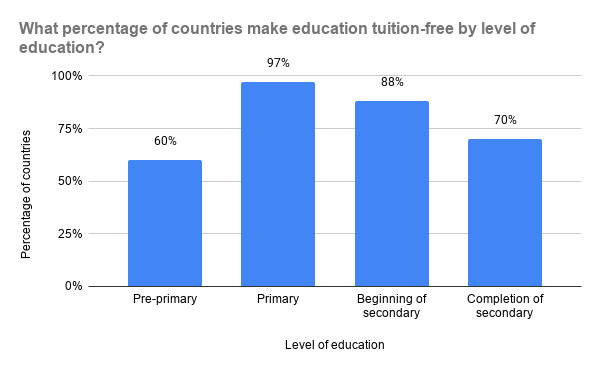
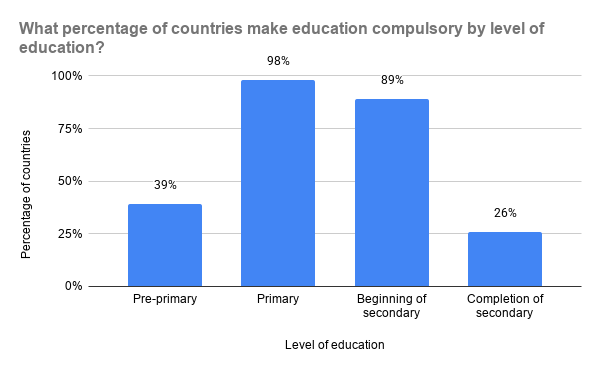
- As of 2026, 97% of countries globally have made primary education tuition-free, and 96% make it compulsory. Still, only 23% of countries guarantee that primary schools will charge neither tuition nor additional fees, such as for uniforms or textbooks.
- 88% of countries have eliminated tuition for lower secondary school; 89% make it compulsory.
- In contrast, just 70% guarantee that school will be tuition-free through the end of secondary, and completing secondary is compulsory in only 26% of countries. Only 14% explicitly prohibit both tuition and other fees through the end of secondary.
- Similarly, just 60% of countries guarantee at least one year of tuition-free pre-primary school, which is compulsory in 39% of countries. An additional 2% commit to progressive realization.
Why it Matters
What Countries Can Do
- Countries can support the development of a new optional protocol to the Convention on the Rights of the Child, which would expand the international right to education to include at least one year of free pre-primary school and all of secondary school.
- In the meantime, countries can continue to expand their own protections for tuition-free and compulsory education, which will require investing adequately to ensure full implementation; international benchmarks recommend a minimum of 4-6% of GDP.
- The global community has a role to play in ensuring this is feasible in the lowest-income countries, including through both direct financial support and debt relief, especially as debt payments now exceed spending on education in 113 countries.
Resources:
For media or partnership inquiries, e-mail: nick@equalfutures.org.

